
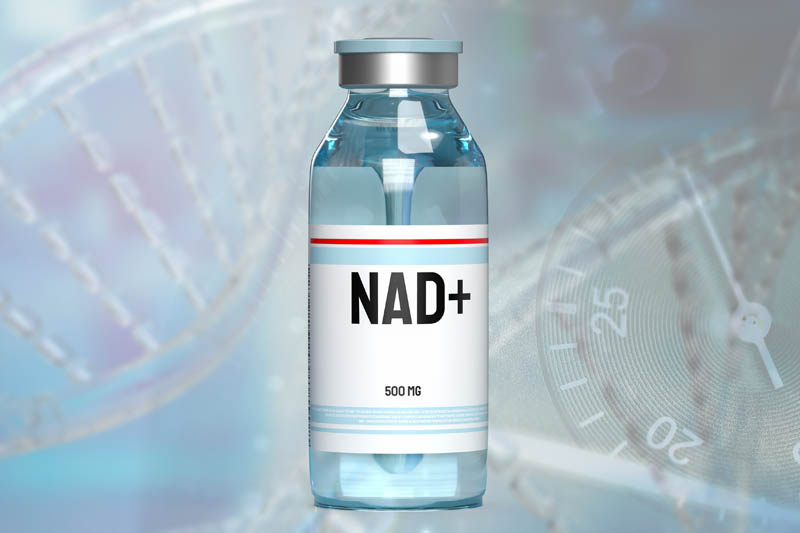
Why do we get tired as we age? Why does our skin sag? Why do we (figuratively) fall apart? It’s because cellular repair is not happening like it used to.
The most recent target for healthy ageing — for cellular wellness — comes from a molecule known as nicotinamide adenine dinucleotide (NAD+).
NAD+ is the most abundant molecule in the body besides water. It is fundamental for existence.
Without adequate NAD+, for example, we would perish in 30 seconds. Literally.

Eric Anderson, Managing Director at NXT USA, Inc., takes up the story.
The primary role of NAD+ is to protect and repair the cell. It is fundamental for cellular function. Why does that matter?
Because healthy cells mean healthy tissues, which translates to healthy organs, systems … and a healthy body.
NAD+ aids in the process of turning nutrients into energy from inside the mitochondria — the cell’s power plant. This is a crucial part of cellular metabolism and the beginning of every energy driven process in our bodies.
In simple terms, NAD+ picks up tiny “energy packets” (electrons) from food and delivers them to structures in the mitochondria; this flow of energy allows the cell to make adenosine triphosphate (ATP), the fuel that powers our body’s cells.
In addition, NAD+ boosts the activity of sirtuins: proteins involved in regulating gene expression, DNA stability and cellular ageing.
NAD+ impacts most of the 12 hallmarks of ageing: mitochondrial dysfunction, protein balance, altered intercellular communication, deregulated nutrient sensing, DNA damage, telomere attrition and cellular senescence.
All this activity goes unseen, of course, but the effects of optimal cellular wellness are profound. Studies show that boosting NAD+ levels improves mental acuity, immunity, physical performance, how we age and how we feel.
Accumulating research since the turn of the century led to the first commercialised NAD+ supplement a decade ago.
Today, it’s a veritable gold rush as research reveals new ways to address the twin pillars of healthspan and lifespan.
The category catches fire
The healthy ageing category is expanding at an exceptional pace. In 2023, Nutrition Business Journal (NBJ) projected that the market would reach $1 billion by 2026; however, by the end of 2025, it had already surpassed that milestone, reaching $1.3 billion and growing at 14.3% — nearly three times the overall supplement industry growth rate of 5.2%.
NBJ expects this momentum to continue, forecasting double-digit growth and a market size of $1.75 billion by 2028.
Healthy ageing, according to an NBJ report on the subject, is redefining the nutrition industry. Its consumer surveys revealed a “surprising” uptake of healthy ageing supplements by those still in their salad days of 35–49 years old.1
Maybe that’s because word has gotten out about NAD+. After all, NAD+ levels peak in our early 20s — supporting robust cellular energy and repair functions.
The skin is smooth. The muscles are taut. By the age of 30, NAD+ levels start to decline and, by 50, a person has half their peak lifetime NAD+ stores.2
Kids these days seem to have learned that mortality will come for them, too, and they’re turning to supplements early to keep them feeling young and immortal.
The first wave of NAD+ precursors
The problem with NAD+ is that it is too large a molecule to be taken orally. Celebrities have announced getting intravenous NAD+ … but that approach is invasive and expensive.
Researchers have discovered that precursors can also do the trick. Key ingredients here are vitamin B3 derivatives such as niacin, nicotinamide, nicotinamide riboside (NR) and nicotinamide mononucleotide (NMN).
Precursors are building blocks that cells use to replenish NAD⁺. Nicotinamide riboside (NR) is converted to nicotinamide mononucleotide (NMN), which is enzymatically transformed into NAD⁺ inside the cell.
This helps to maintain the cellular processes that depend on healthy NAD⁺ levels.

NR was the first on the market. NMN has recently made a name for itself because the US FDA granted a New Dietary Ingredient (NDI) notification in 2022 for NMN — only to backtrack 6 months later and pull the approval when a pharmaceutical company asserted it had investigated NMN for drug use before the NDI notification went through.
That lasted 3 years, until September 2025, when the FDA approved NMN as a dietary ingredient after all.
New avenues for NAD+ support
There are other ways to support and complement NAD+. The current approach, emblematic of NR and NMN, is to upregulate NAD+ production.
But there are more efficient ways ... and chief among them is the new concept of reducing NAD+ degradation.
Through our work with Prof. Mathias Ziegler from the University of Bergen in Norway, we have developed a botanical formulation that does more than just enhance NAD+ production.
Precursors such as NR and NMN only stimulate the Salvage pathway. A novel botanical formulation, called BluNADBooster, also activates the Preiss-Handler pathway, an often-overlooked but critical pathway for whole-body NAD+ replenishment.
By activating two NAD+ biosynthesis pathways, BluNADBooster expands cellular NAD+ generation beyond what precursors alone can achieve.
What’s more, this natural botanical blend also — and uniquely — prevents NAD+ degradation by inhibiting the CD38 enzymes that consume NAD+.
The new calculus in NAD+ powered cellular wellness is that it’s not just how much NAD+ you produce but how much you keep.
The discovery of the two botanicals that power this formulation came about after 900 botanical candidates were screened for their biological activity. The hero plants are
- a polyphenol-rich pomegranate extract that promotes NAD+ activation and protects against oxidative stress
- marigold flowers (Tagetes erecta): a source of natural lutein compounds that support mitochondrial and inflammatory balance.
A published clinical study found BluNADBooster was superior to NR in terms of increasing NAD+ levels in a head-to-head comparison.3
Outcomes included increased NAD+ levels, CD38 activity, inflammatory biomarkers, cognitive function, physical performance and quality-of-life measures. What’s more exciting is that one arm of the study combined NR with BluNADBooster and found the combination worked best of all.
That provocative finding should open the way for additional research and development in the healthy ageing category.
It also paves the way for supplement brands to continue innovating by combining ingredients or by employing technologies such as liposomes to increase efficacy.
BluNADBooster delivers differentiated intellectual property, biological superiority and clinically validated advantages, positioning it as a category leader for longevity, mitochondrial health and metabolic wellness.
These types of groundbreaking discoveries in cellular wellness will help to grow the market for longevity nutraceuticals. It will also enable supplement buyers in their quest to keep expanding their healthspans and lifespans.


