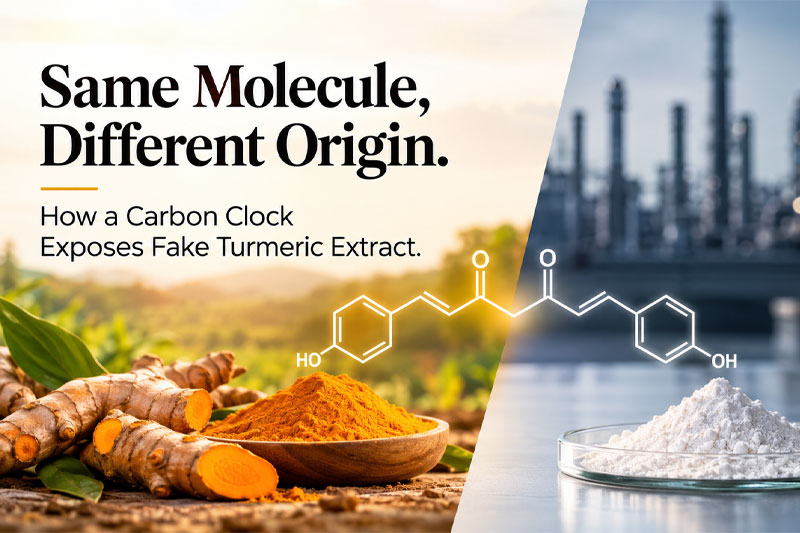
Now look at the label on your own turmeric supplement. Natural. Standardised to 95% curcuminoids. Made from Curcuma longa root. Most of us take those words on trust. The uncomfortable truth is that some of the "turmeric" in those capsules may never have been near a turmeric field.
A fake that passes the usual tests
Curcumin, the golden compound that gives turmeric its colour, can also be made in a factory from petrochemical starting materials. That synthetic version sells for roughly a third of the price of the natural extract, in a global turmeric supplement market forecast to grow from $1.9 billion in 2024 to $2.9 billion by 2030. A price gap like that, in a market that size, gives dishonest suppliers every reason to blend it in quietly and still call the product natural.
It's no surprise, then, that the review behind those numbers, published this year by the Botanical Adulterants Prevention Program, named synthetic curcumin as the most common adulterant in supplements, turning up most often in Europe and North America.
What makes it so hard to catch is that the molecule looks the same. Standard lab tests check for curcumin's three characteristic peaks, and synthetic curcumin produces them too. DNA testing can't help either, because a lab-made molecule carries no plant DNA. On paper, the fake passes.
Every plant leaves a carbon fingerprint
The test that sees through it borrows from archaeology. Every living plant takes in carbon dioxide from the air, and that air contains a tiny, steady trace of a naturally occurring form of carbon called carbon-14. A turmeric plant builds that carbon-14 into every curcumin molecule it makes.
Petrochemicals tell a different story. They come from plant matter buried millions of years ago, long enough for every trace of carbon-14 to disappear. So, curcumin made from them contains essentially none.
Using a highly sensitive instrument called an accelerator mass spectrometer, specialist labs can measure how much carbon-14 a sample holds. Natural curcumin carries the modern signature. Synthetic curcumin reads as "dead" carbon. A blend lands somewhere in between, which means the test can estimate not only whether a product has been cut, but by how much.
What testing has found in samples
When the Global Curcumin Association funded testing of 14 products labelled "all natural", combining carbon-14 analysis with standard potency testing, only four had results that supported their label claims. That's fewer than three in ten. The two methods work best as a pair: carbon-14 confirms origin, potency testing confirms strength.
Suppliers are seeing it too. Ingredient makers say their own testing found some commercial materials containing more than 40% synthetic compounds, built to slip past routine quality checks.
And synthetic curcumin isn't a like-for-like swap. Natural turmeric extract carries a broader mix of plant compounds that a lab-made molecule simply lacks, and the US FDA has declined to grant synthetic curcumin "Generally Recognised As Safe" status.
What you can do as consumers
You can't run a carbon-14 test at home, but you can ask the right questions. Look for brands that name their extract supplier and share third-party test results. Be wary of prices that look too good for a "95% curcuminoids" claim. And ask, plainly, whether the curcumin has been carbon-14 tested. A brand confident in its supply chain won't mind the question.
At K. Patel Phyto Extractions, we make curcumin from turmeric that is traced from the farm to the finished extract, because we believe where an ingredient comes from matters as much as what's in it.
Natural should mean natural. Carbon-14 is how you check.
Sources:
-
Gafner S et al. A scoping review of turmeric adulteration based on data from six continents. Pharmaceutical Biology 2026; 64(1): 87–107 (https://doi.org/10.1080/13880209.2025.2606229); summary and market figures via NutraIngredients, February 2026 (https://www.nutraingredients.com/Article/2026/02/16/turmeric-adulteration-presents-significant-opportunity-for-responsible-industry)
-
ABC-AHP-NCNPR Botanical Adulterants Bulletin on turmeric, 2018 (summary: https://www.wholefoodsmagazine.com/articles/8308-abc-publishes-turmeric-adulteration-bulletin)
-
Analytical strategies to determine the labelling accuracy and economically-motivated adulteration of "natural" dietary supplements: Turmeric case study, Food Chemistry (https://doi.org/10.1016/j.foodchem.2021.131007); summary: https://www.nutritionaloutlook.com/view/recent-study-highlights-new-analytical-strategies-for-improving-turmeric-quality
-
Stable Isotope Ratio Analysis for the Authentication of Natural Antioxidant Curcuminoids from Curcuma longa (https://www.ncbi.nlm.nih.gov/pmc/articles/PMC9952763/)
-
Beta Analytic, Carbon-14 Analysis of Curcumin (https://www.betalabservices.com/natural-products/curcumin-analysis.html)