

In a crowded market, consumers are seeking stronger signals of credibility
In an expanding health sphere with AI platforms and social media, people are increasingly unsure of what information or product claims they can trust. The Edelman Trust Barometer reports that consumer confidence in the ability to make informed health decisions has sharply fallen by 14 percentage points (77% to 63%) since 2025.1, 2
These decisions are made in a crowded retail and information environment. A 2026 consumer survey by Nutrition Business Journal (NBJ) showed the top channels where Americans are buying their supplements:
- Mass market retailers (27%)
- Natural and specialty outlets (25%)
- E-commerce websites (24%)3
Unsurprisingly, doubts about effectiveness (52%) and lack of scientific evidence (45%) are among the top reasons consumers reject a supplement (according to a 2025 YouGov survey of 1,000+ US adults).4
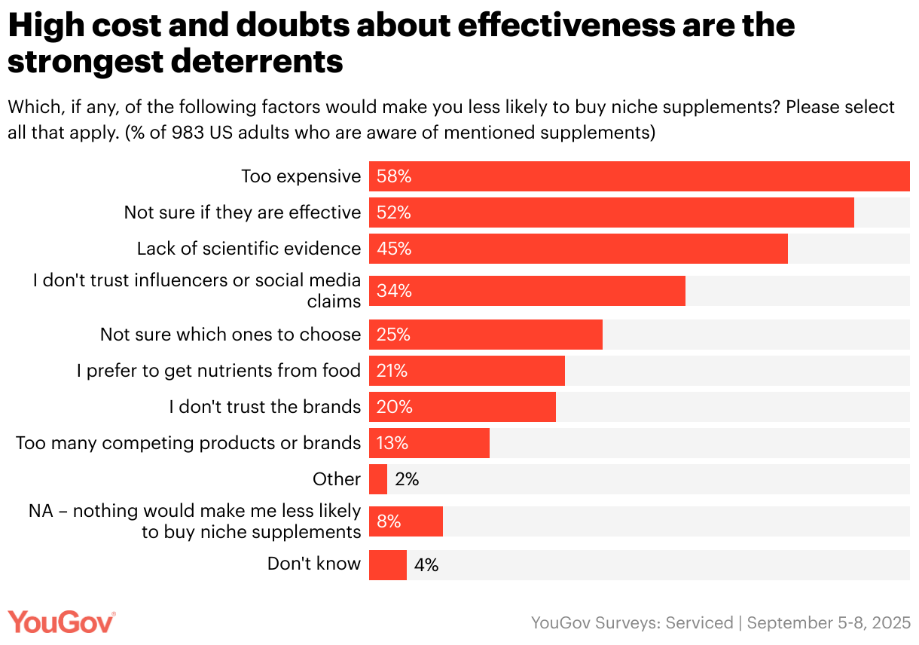
So, consumers are increasingly looking for credibility signals to inform their supplement purchase decisions.
Mainstream channels like CVS and Amazon are enforcing transparency standards
Pharmaceutical retail giant CVS mandates third-party testing of vitamins and supplements through certifiers like NSF, USP and Eurofins. Their “Tested to be Trusted” program intends to ensure that vitamins and supplements contain dietary ingredients in the exact amounts listed on the product label.5 They also screen against heavy metals, pesticides, known adulterants and other contaminants. Additionally, suppliers are required to manufacture products in facilities that are registered with the FDA and follow good manufacturing practices.
Amazon requires dietary supplements to undergo third-party compliance verification through approved Testing, Inspection and Certification (TIC) organisations like NSF, Eurofins, SGS, CL and UL.6 They also need to be manufactured in a facility compliant with FDA’s 21 CFR 111 or 21 CFR 117. GMP (Good Manufacturing Practices) certification must be provided by an accredited third-party as well.7
Their Compliance Fast-Track program validates dietary supplements certified by select partners like BSCG Certified, Clean Label Project, GRMA, INFORMED, NSF and USP. Amazon collects relevant certificates directly from the certifying organisation for a quicker, lower-cost process.8
However, other large US retailers are still operating on ingredient exclusion lists (Target, Whole Foods) or certification for their private-label products (Costco, GNC), not blanket third-party verification requirements across all the brands they carry. For brands selling across multiple retail channels, understanding these requirements early can reduce compliance friction as products enter new markets and outlets.
The FDA’s regulatory approach to supplements is expected to evolve
In February 2026, the Food and Drug Administration (FDA) released an official statement, which reads: “Given the rapid growth of the dietary supplement marketplace and the more than 30 years since enactment of the Dietary Supplement Health and Education Act of 1994 (DSHEA), HFP (Human Foods Program) will evaluate new and modernised regulatory approaches that protect the public health while supporting a responsible dietary supplement industry. HFP will continue to support dietary supplement priorities with targeted enforcement strategies on violative products.”9
In March this year, the FDA convened stakeholders in a public forum to revisit the scope of dietary supplement ingredients.10 One of the themes discussed was how the statutory definition of “dietary substance” applies to emerging ingredient types, drawing input from the Council for Responsible Nutrition (CRN), Natural Products Association (NPA) and academic voices.
As reported by the SupplySide Supplement Journal, an FDA spokesperson wrote “HFP is exploring ways to operationalise third-party data to inform and improve our risk prioritisation efforts. We are increasingly interested in leveraging data from certification programs, marketplace intelligence and robust external research to better focus our resources where they are needed most.”11
This means that supplements will not only be scrutinised by consumers and retailers, but increasingly by regulators as well.
Meeting regulatory and retail requirements establishes a baseline for product quality. It doesn’t, by itself, answer a different question consumers ultimately care about: “Does the product actually deliver its intended benefit in a consistent, well-supported way?”
Consumer-trusted brands go beyond compliance and address formulation
A supplement can meet its labelling and manufacturing requirements and still leave consumers questioning efficacy. The relevant question is therefore:
“How does the formulation help the active ingredient dissolve, get absorbed, and ultimately deliver results?”
Research on oral delivery consistently shows that solubility, dissolution, permeability, formulation composition and physiological conditions can all influence absorption.
- Some ingredients are poorly soluble in water, which can limit their dissolution and absorption.12 Lipid-based delivery systems can improve solubility and reduce dissolution-related limitations for suitable ingredients.13
- Release timing may be relevant where an ingredient is intended to become available in a particular part of the gastrointestinal tract.14 The same active ingredient can be delivered in different phases through modified-release pellets for immediate, sustained, delayed or multiphasic release. In a human urapidil study, one pH-dependent pellet formulation achieved 11% higher relative bioavailability, while another achieved 27% less than the reference.15
- Coated pellets and beadlets can change release behaviour within the same dosage form. In a human itopride study, sustained-release pellets produced approximately 2% and 8% greater relative bioavailability under fed and fasting conditions, respectively, indicating broadly comparable exposure.16 In a human metformin hydrochloride study, different amounts of sustained-release pellet coating produced 2.4% less and 65% more relative bioavailability than the reference standard.17
Modified-release technology is a formulation tool rather than a blanket bioavailability advantage. Its effect depends on the ingredient, coating, release mechanism, dosage form and physiological conditions. So, the product must be intentionally formulated to account for each of these factors.
Formulation science can be a consumer trust point
Transparency is the result of having something credible to show. A brand’s scientific advantage can become part of its marketing story when it explains a real formulation decision in accessible language.
For example:
- Why does this ingredient need a lipid-based delivery system?
- Why is this product designed for delayed or sustained release?
- What does a multi-phase release profile mean?
- Why does the formulation use pellets or beadlets?
- What testing supports the product’s release, stability or label accuracy?
This gives consumers something more meaningful to evaluate. They can understand what the formulation is designed to do and what evidence supports the finished product, while the brand gains a concrete point of differentiation.
The supplement brand checklist to develop trusted supplements
- Ingredient assessment: How do you evaluate solubility, compatibility, interactions and other properties that may affect nutrient delivery?
- Formulation strategy: Why is the proposed dosage form or delivery technology appropriate for this set of ingredients?
- Release performance: What release or dissolution profile is the formulation designed to achieve?
- Shelf life: What stability studies are appropriate for the target shelf life?
- Manufacturing consistency: How will the formulation be transferred and reproduced at commercial scale?
- Verification: How will the finished product be tested against its specifications and label?
- Market requirements: What documentation, testing or third-party verification will be needed for the target market and retail channels?
- Consumer communication: Which formulation benefits can be explained accurately without overstating the evidence?
Conclusion
Trust is built through the decisions, controls and evidence behind the product. For supplement brands, formulation science provides a way to make those decisions more deliberate, the evidence more meaningful and the product story more credible. Clear scientific explanations give consumers more information with which to evaluate a product, while helping brands communicate formulation sophistication without relying on vague performance claims.
We help brands develop and manufacture high-performance supplements
At Vantage Nutrition, we support supplement brands with formulation development, ingredient-excipient compatibility, dissolution testing, controlled-release beadlet development and reliable manufacturing at scale. This ensures complete control over the entire production process.
Our proprietary V-Beads, V-Fill and V2 delivery technologies provide flexible nutrient release and dosage-form design options to suit the ingredient’s performance requirements.
Using pharma-grade ACG equipment, our manufacturing facilities are GMP compliant. Our plant in Chadds Ford, Pennsylvania complies with FDA 21 CFR part 111 (current Good Manufacturing Practice for dietary supplements).
So, we not only help you craft a formulation that lends itself to a science-backed brand story, but also help you manufacture it reliably at scale.
References:
- https://www.edelman.com/trust/2026/trust-barometer/special-report-health
- https://www.edelman.com/sites/g/files/aatuss191/files/2026-06/2026%20Edelman%20Trust%20Barometer%20Special%20Report%20Trust%20and%20Health_U.S.%20Report.pdf
- https://www.nutraceuticalsworld.com/exclusives/u-s-supplement-sales-hit-72-88-billion-as-sports-nutrition-and-digital-discovery-drive-growth/
- https://yougov.com/en-us/articles/52965-inside-supplement-habits-what-americans-are-buying-and-why-they-hesitate
- https://www.cvs.com/content/tested-trusted
- https://sellercentral.amazon.com/help/hub/reference/external/GUTZ2R2DD6P2UMVB
- https://sellercentral.amazon.com/help/hub/reference/external/G55N3JF2WQS7RVNE
- https://sellercentral.amazon.com/help/hub/reference/external/GNHU43TN2RHER9BQ?locale=en-US
- https://www.fda.gov/about-fda/human-foods-program/human-foods-program-2026-priority-deliverables
- https://www.fda.gov/food/workshops-meetings-webinars-food-and-dietary-supplements/public-meeting-exploring-scope-dietary-supplement-ingredients-03272026
- https://www.supplysidesj.com/supplement-regulations/dietary-supplement-oversight-modernization-sparks-debate
- https://www.sciencedirect.com/science/article/abs/pii/S1359644613002808?via%3Dihub
- https://www.mdpi.com/2218-0532/79/4/705
- https://www.sciencedirect.com/science/article/abs/pii/S0378517310003431?via%3Dihub
- https://www.tandfonline.com/doi/full/10.3109/10837451003592191
- https://www.tandfonline.com/doi/10.1080/03639045.2018.1546312
- https://www.sciencedirect.com/science/article/abs/pii/S0939641106000889?via%3Dihub


