
Often misunderstood, steam powers a wide range of modern industrial processes, from precision industrial-scale cooking through to electronics manufacturing. Getting steam control right is critical, not just for application performance, but also for efficiency, maintenance and safety requirements. Specialist training on steam system design and management ensures that engineering teams can optimise their systems and develop tailored solutions.
Kieran Bennett, Technical Sales Engineer & Trainer at flow control specialist Bürkert, explains.
To the lay person, describing a process as ‘steam powered’ harks back to a bygone age of industry, yet today steam is still used extensively across cutting-edge processes that require clean, controllable, high-intensity heat.
In food production, steam is used for its precision and efficiency in industrial cooking processes, and it’s also essential for temperature control in brewing and distilling. Steam is also crucial where optimum hygiene is needed, such as sterilisation in place (SIP) for pharmaceutical applications. Even in electronics manufacturing, steam is used for drying processes because its latent heat drives rapid evaporation of residual moisture, leaving equipment dry once condensate has drained. At its largest scale, steam is relied on across various power generation applications, with power stations using it to drive turbines and generate electricity.
Although the vapour from a kettle is often mistaken for steam, in true terms steam is an invisible gas. Saturated steam exists at the temperature corresponding to its pressure and coexists with water, while superheated steam is heated above this point and is a dry gas containing no liquid.
Ensuring correct specifications
However, it’s not just the lay person that has misconceptions about steam. Engineers can also fall into the trap of calculating steam requirements as if they are dealing with a standard gas. Steam has unique properties and failure to fully consider all implications can lead to incorrect specifications of valves and flow apparatus, ultimately giving rise to system failures and inefficiencies.
The crucial difference is that steam delivers energy by condensing, not by flowing. As a result, valve sizing and control systems that ignore phase change, expansion and choking will be unstable, inefficient and non-compliant. From a performance perspective, errors in specifying the right size or type of valve for steam control can cause unstable or sub-optimal flow, as well as pressure drops, ultimately preventing the system from achieving and maintaining precise temperature requirements.
Generally, calculation errors lead to valve oversizing, which is also a frequent cause of excessive operational noise. Attempts to diagnose the challenge can often be mistaken for a product quality issue rather than inaccurate specification.
Efficiency and safety challenges
Inefficiency is another common challenge introduced by oversizing, where excess steam flow wastes energy and adds costs. At higher cost still, there are maintenance challenges and downtime that can result, and while oversized valves can damage valve seats, undersizing can lead to thermal stress.
Crucially, there are also key safety implications for dealing with steam, requiring significantly stricter protocols compared to the use of other gases or liquids. For example, the risk factor typically demands two forms of lockable isolation between live steam and equipment undergoing maintenance, whereas for virtually every other liquid or gas application a single form of isolation is usually considered sufficient.
As a result of the potential for challenges when working with steam, specialist knowledge surrounding its control is crucial, but expertise in steam engineering is declining. A key reason is that, working well for decades and viewed almost as a utility, steam has become invisible infrastructure. Compounding this issue, infrastructure around steam generation and management is obscured, with greater focus on the machine’s drive components and production output. This coincides with the decline of steam-heavy industry in the UK, even though steam remains ubiquitous and vital.
Steam training
At JBT Marel’s operation in Livingston, West Lothian, steam is used across several processes. JBT Marel is a global food technology corporation that develops cooking and freezing technologies, and the engineering management team wanted to update its technical knowledge. With experience across the group ranging from 1 year in the role to more than 30 years, expertise in steam control varied, so JBT Marel commissioned Bürkert to provide steam system design and management training that would enhance and standardise competencies.
“The more knowledge we have, the more valuable our support can be on the front line,” said Darren Steel, Engineering Manager, JBT Marel. “Some members of my team had attended the training before, and I jumped at the opportunity for the remainder to get the training after such a positive response.”
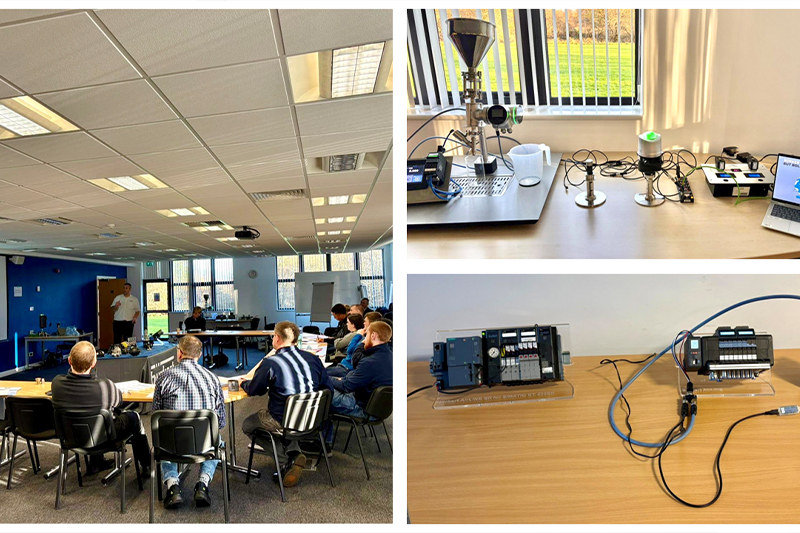
Bürkert’s two-day course includes the fundamental properties of steam, including how to use steam tables and make essential calculations. The primary emphasis of the training is on the practical application, including the key steps for steam design to optimise performance and efficiency, as well as ensuring critical safety protocols, such as isolation requirements.
Increasing knowledge
“The training has had great feedback from the team,” said Darren. “It was really beneficial and gave us a lot of great information, adding a real increase in our knowledge of designing and using steam systems.”
In real terms, the training has given the JBT Marel engineering team the ability to precisely assess its steam lines and machines to enhance performance as well as predictive maintenance, plus the confidence to troubleshoot issues for customers using its systems. Crucially, it’s also enabled the team to develop new solutions, in particular those for customer-specific demands.
To learn more about steam control and book onto Bürkert’s steam training courses, visit here


