

As a full-service supplement contract manufacturer with decades of experience, we can say this: the supplement industry tends to overcomplicate things.
For many founders, everything starts with formulation: unique ingredient combinations, novel blends, and patented compounds. Months are spent refining products before a single customer ever sees them. It feels logical: if the product is better, success should follow.
But the market operates differently today.
Formulation still matters. Quality, safety, and bioavailability remain non-negotiable. But they are no longer the deciding factor between success and failure. Instead, success is driven by speed, positioning, and branding.
This shift is not theoretical. It reflects how the market behaves today and changes how supplement brands should be built.
How the supplement market is changing and what that means for brands
The supplement market has matured.
There are thousands of products in every category, and most ingredients are widely available. Even “unique” formulations often overlap significantly with existing products.
At the same time, consumer behavior has evolved:
- Product discovery increasingly happens on social media
- Trust is often built through branding and storytelling
- Purchase decisions are made quickly, often without deep comparison
In this environment, differentiation still matters, but it has shifted from product to perception.
The changing supplement landscape requires a fundamentally different approach to product development. We’ve identified seven key market shifts, along with legacy product development approaches that no longer consistently hold up.
1. The formulation trap
Many brands still believe they need to perfect their product before launching. In reality, this often slows them down.
Complex formulations can extend time to market to 9–12 months, increasing costs and reducing momentum. By the time the product launches, the market may have already moved on. The issue is rarely product quality but timing.
2. The “more is more” misconception
Another pattern we see often is brands wanting to create supplements with long ingredient lists. They want to cover all possible needs and enable the use of approved health claims through certain ingredients.
Some ingredient combinations can even reduce product effectiveness. Also, a long ingredient list is not necessarily a strong purchase criterion for consumers.
All in all, brands often invest time and resources into complexity that does not necessarily translate into better market success.
Of course, there are cases where complex formulations are justified. But more is not automatically better. In fact, there are many current market shifts that demand a more agile approach.
3. Speed is more important than ever
Trends in supplements move faster than ever.
Driven by social media, influencers, and online communities, demand can rise and fall quickly. Brands that launch early capture attention, while late entrants are often pushed into price competition.
The creator economy further accelerates this dynamic. Digital-native entrepreneurs prioritize audience, storytelling, and speed over product complexity. They focus on launching something that resonates fast.
Speed does not replace quality. But without speed, quality might go unnoticed.
4. The myth of differentiation
Many brands aim to create “unique” products. In practice, this uniqueness is often incremental: slightly different dosages or ingredient combinations.
Scientifically, these differences may matter. For consumers, they might not be that important when making a purchase decision.
Also, there are very few truly unique ingredients.
Most brands work with the same building blocks: vitamins, minerals, plant extracts, probiotics, and functional compounds. Even advanced formulations are often combinations of widely available components.
While patented ingredients exist, developing them takes time, bringing us back to the importance of speed.
This gap between scientific differentiation and perceived differentiation is where many brands struggle.
5. The rise of the brand as the real differentiator
When products appear similar, customers rely on signals they can quickly understand. A strong brand is one of the most powerful signals customers rely on.
There are many examples of how strong brands set companies apart in crowded markets. Brands like Seed and Ritual entered saturated markets but built strong businesses through clear positioning and consistent communication. Their success was not based on inventing new categories, but on making their value visible and trustworthy.
Formulations can be replicated. Supply chains can be built. But a strong brand, one that understands its audience and communicates consistently, is much harder to copy.
The focus, therefore, shifts from what is inside the capsule to what surrounds it.
6. Validation over invention
Most supplement products do not fail because of formulation; they fail due to a lack of demand.
Testing ideas early is crucial. Launching a product, gathering feedback, and iterating allows brands to avoid investing heavily in products that do not resonate.
This approach is standard in many industries but still underused in supplements.
A new approach to product development
Based on these shifts, we suggest that supplement companies take a new approach to product development. We do not suggest formulation is irrelevant, but its role has changed.
A more effective model is emerging:
- Start with a high-quality product
- Launch quickly and test demand
- Build brand and positioning
- Refine and differentiate once traction is proven
In this model, formulation becomes an ongoing process rather than a prerequisite. The starting point also changes from private label to white label solutions.
White label: offering speed and quality at the same time
White label products have become one of the most efficient ways to launch supplements in current market conditions.
Many might still have a slightly outdated perception of white label products:
- Generic
- Low differentiation
- Temporary solution
In this context, white label products are better understood as:
- The fastest route to market
- A tool for validation
- A foundation for brand building
White label is not the end state, but a starting point. It allows brands to focus on what drives early success: speed, positioning, and learning.
Custom formulations still matter, but they become more valuable once demand is proven.
What this means for supplement brands
For founders and teams, the implications are clear:
- Do not wait for the perfect formulation
- Do not assume complexity guarantees success
- Focus on understanding your audience
- Use speed as an advantage
Using white label products does not mean lowering standards, but aligning the effort required to launch a supplement with its actual impact.
To support this shift in how supplements are developed and launched, we created 1Q Shop
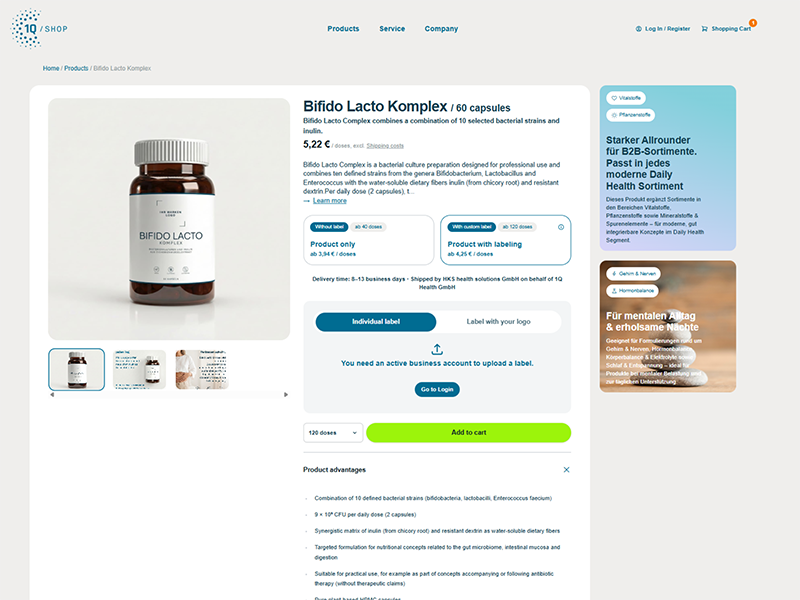
Being a full-service supplement contract manufacturer for all dosage forms with decades of experience, we have seen both sides: the depth of formulation work and the reality of how supplement brands grow.
As speed, validation, and execution become more important, brands need tools to act on that. Alongside our traditional CDMO services, we also help our customers successfully launch their finished products, with for example digital marketing services.
This spring, we added a new tool to our offering to enable our customers to answer the demands of the changing market landscape even better: 1Q Shop.
With it, brands can order ready to launch, science based white label formulations produced under strict European quality standards with just a few clicks. Tools like our upcoming Trendradar help identify emerging trends and enable faster decision making.
When the time is right, we also support the transition to custom private label formulations.
White label does not replace custom development; it complements it. It allows brands to move faster, reduce risk, and build a stronger foundation for future success.
Closing thoughts
The supplement industry might not become any simpler, but it is getting clearer.
The brands that succeed are not necessarily those that perfect every detail upfront. They are the ones that understand their audience, move at the right speed, and build trust.
For those willing to adapt, this shift creates real opportunity. We are here to support them on that journey.
Visit us at Vitafoods at booth 3K128 to discuss how we can help you successfully launch your supplement.


