Few micronutrients have travelled as far, as fast, as menaquinone. A decade ago, vitamin K2 was a specialist ingredient known mainly to bone-health formulators and a small circle of cardiovascular researchers. Today, it is one of the most widely co-formulated vitamins on the shelf, with a launch record to prove it. An Innova Market Insights data export of 5,917 vitamin K2 product activities, logged globally over the last five years, is less of a list and more of a map of where the category has been and where it is heading.
Read at the product level rather than at the headline level, four patterns stand out:
-
K2 has become a partner ingredient rather than a hero.
-
Its delivery formats are fragmenting fast.
-
Its packaging is converging on a single dominant archetype while novel formats probe the edges.
-
Its target audiences are widening well beyond the bone-and-heart core.
Below, we consider the following four market lenses: format, packaging, target audience and indication, each of which has standout launches that are hiding within the data.
1. Format: the softgel’s quiet decline and the dose you no longer swallow
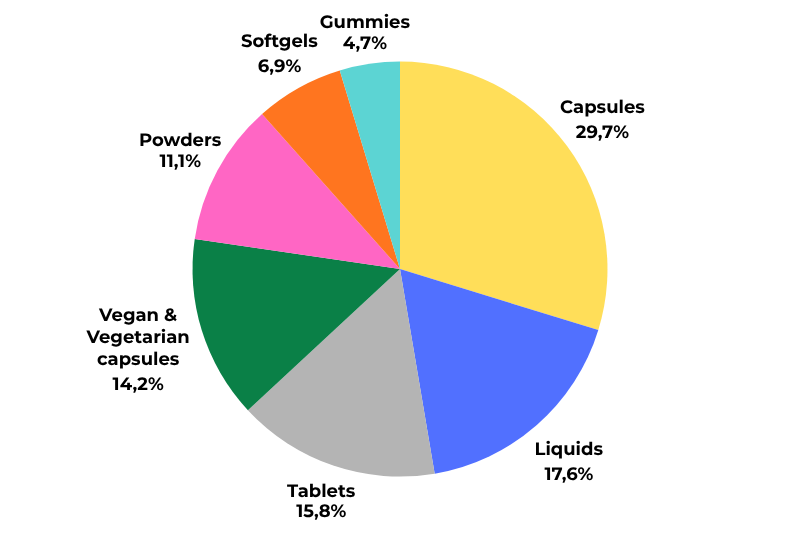
K2 is fat-soluble, which historically meant that an oil-filled softgel was the obvious carrier. The data tells a more crowded story. Among launches with a defined format, capsules (1,447) lead, but vegan and vegetarian capsules (692) now outnumber traditional soft gels (335) by more than two to one, with liquids (855), tablets (767), powders (540) and gummies (228) filling out a genuinely fragmented field. The most revealing figure isn’t any one format’s size, rather it’s the collapse of the softgel’s former default.
692 vs 335
Vegan/vegetarian capsules now outnumber traditional soft gels more than 2:1 - a structural shift for a fat-soluble nutrient that once defaulted to gelatin.
That shift is driven not by chemistry, but by audience. MK-7 menaquinone is typically fermentation-derived (natto or chickpea), which makes a fully plant-based claim achievable, with roughly three in ten launches now carrying a vegan claim. For formulators, this is the live frontier: protecting an oxidation-sensitive, oil-soluble molecule inside formats never designed for it.
The most interesting cases sit at the convenience end of the market, in particular:
-
Oral sprays - BetterYou and Cytoplan’s D3+K2 sprays, KIKI Health’s peppermint-flavoured spray reframe a daily pill as a one-second mist, betting on adherence over capsule economics.
-
Liposomal delivery - appears in around 125 launches (Darvita’s Liposomale D3+K2, PromoPharma’s pocket sachets), borrowing an absorption-led narrative from the CoQ10 and glutathione categories.
K2 is also turning up in effervescent tablets, functional shots and stick-pack sachets formats, each of which treats a supplement as a beverage moment rather than a regimen. None is mass-market yet; together they signal a category competing on experience, not just ingredients.
2. Packaging: one archetype rules, and the exceptions reveal who’s innovating
Packaging is where K2 looks most conservative, and that conservatism is itself the insight. Around two-thirds of launches use a re-closeable rigid pack: the classic HDPE or glass pill bottle with a screw cap. For a light- and oxygen-sensitive oil-based active, rigid-and-recloseable is not laziness, but rather functional barrier protection.
~65%
of K2 launches use a recloseable rigid pack, a protective default for an oxidation-sensitive, fat-soluble active. The deviations are where the strategy lives.
The deviations carry the story. Flexible and resealable formats, such as stand-up pouches, foil sachets, and stick packs, cluster around two very different buyers: powder-format sports and clinical-nutrition products on the one side, single-dose travel and trial formats on the other. PromoPharma’s liposomal ‘pocket’ sachets are the clearest tell, their packaging being engineered for the bag, not the bathroom cabinet. Multipack and compartment packs point to the daily-pack and ‘vitamin stack’ trend, where K2 travels inside a curated regimen rather than standing alone.
Sustainability messaging remains nascent: recyclable and reusable descriptors appear on only a small fraction of packs. For a category whose core consumer skews health-conscious and label-literate, the gap between K2’s natural, clean-label storytelling and its largely conventional plastic packaging is a visible and addressable opportunity for brands willing to move first.
3. Target audience: K2 escapes the over-50 bone aisle
If you still picture the K2 buyer as a post-menopausal woman managing bone density, the launch data has moved on without you. K2 is now formulated for almost every life stage at once.
The clearest surprise is paediatric and infant nutrition: 563 launches sit in the Baby & Toddler category, 445 of them in baby formula and milk, where K2 is increasingly a standard inclusion supporting calcium handling during rapid skeletal growth. At the other end of the registry, 479 Clinical Nutrition launches, featuring oral and tube-feeding formulas, place K2 squarely in medical and elderly-care settings.
563 + 479
Baby/toddler launches plus clinical-nutrition launches - K2 now bookends the entire human lifespan, from infant formula to tube feeding.
Between those poles, three growth audiences stand out.
-
Sports and active nutrition - 371 launches reference K2’s role inside recovery, joint-support and ‘muscle multi’ stacks, (eg Just Ingredients’ Daily Recovery, Baxter Labz’ Joint Support), thus leaning on the bone-and-cardiovascular benefits for a performance audience.
-
Women’s health beyond bone - divided into two distinct segments: a menopause and peri-menopause cluster (eg ProVen Biotics, Evera Women’s Balance) and a pregnancy and prenatal sub-segment where K2 features alongside D3 and folate.
-
‘Beauty-from-within’ - roughly 930 launches reference skin, hair or nails, and over 500 pair K2 with collagen. These pull K2 into a positioning that would have looked eccentric five years ago. Children’s flavoured gummies and chewables (eg Holland & Barrett, Nova Pharma) close the loop, making a structural, hard-to-feel benefit palatable to young users.
4. Indications: the D3+K2 axis, and the cardiovascular story still on the table
The single most important pattern in the entire dataset is a pairing. 88.7% of K2 launches also contain vitamin D / D3. K2 has, in effect, become D3’s default co-pilot; the mechanistic logic (D3 raises calcium absorption; K2-dependent proteins help direct that calcium into bone and away from arteries) has hardened into a near-universal marketing axis. Calcium appears on around 77% of launches, magnesium on 56%, vitamin C on 53%. K2 is rarely sold alone and is instead sold as the partner that makes a calcium-and-D regimen ‘work properly’.
88.7%
of vitamin K2 launches also contain vitamin D3 - the D3+K2 pairing is no longer a trend, it is the category’s organising principle.
On stated benefits, bone health leads (about 60% of launches), followed by immune support (around 50%), heart and cardiovascular (around 26%) and teeth and oral health (around 20%). These claims rarely travel alone. ‘Bone + Heart,’ ‘Bone + Immune + Oral’ and four-claim stacks are among the most common combinations, reflecting K2’s genuinely multi-system mechanism.
Two indication signals matter most for where the category is heading. Firstly, the cardiovascular story is still under-exploited relative to the science: despite arterial calcium handling being one of K2’s most compelling and differentiated mechanisms, heart positioning trails bone by more than two to one. Secondly, form specificity remains a marketing blind spot: MK-7 is named on roughly half of launches, MK-4 on under 2%, and explicit ‘all-trans’ bioactive-isomer claims on under 4%. As consumers grow more sophisticated, and as blood-level testing of vitamin K status edges toward the mainstream, the brands that can credibly talk about isomer, trans-configuration and bioavailability will own the premium tier. Notably, most of the market is not yet speaking that language.
5. What it means for the industry
Stack the four lenses together and a coherent picture emerges. Vitamin K2 has crossed from niche active to category infrastructure; one that is embedded across the human lifespan, married to D3 in nearly nine of ten launches, and migrating into formats such as sprays, shots, liposomal sachets and gummies that were unimaginable for a fat-soluble vitamin a few years ago.
Three openings are visible in the white space that the data leaves behind:
-
The cardiovascular narrative is under-built - K2’s arterial-calcium mechanism is its most differentiated story, yet heart positioning lags bone by two to one, leaving an under-occupied premium space for brands willing to invest in the evidence and the biomarker conversation.
-
Form and bioavailability are the next battleground - with MK-7 named on only half of launches and trans-isomer and stability claims still rare, technical differentiation (verified all-trans content, microencapsulation, hydrophobicity, stability) is where commodity K2 separates from premium K2.
-
Format experience is outpacing format chemistry - consumers are pulling K2 into sprays, gummies and shots faster than the science of protecting it there is settled, so suppliers who solve oxidation, water-dispersibility and stability for these formats unlock the category’s fastest-growing edges.
The launches that stand out in this database (the peppermint oral sprays, the pocket sachets, the liposomal D3+K2 shots, the menopause and recovery stacks) aren’t outliers to be dismissed. Product by product, they are the category telling you where it intends to go. The opportunity for ingredient innovators is to meet it there: with K2 that stays bioactive in the formats consumers now want, and the technical credibility to back the claims the premium market tier will increasingly demand.