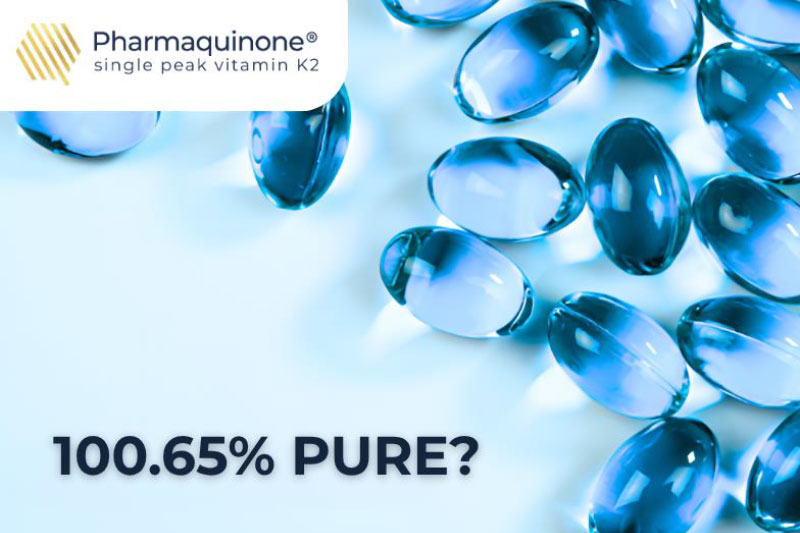
Yet results like this appear regularly on legitimate, well-controlled CoAs for a range of pharmaceutical products. Pharmaquinone® is no exception.
To understand this apparent paradox, we should step back from the headline number and into the analytical chemistry that produces it. This is a useful exercise for any buyer, quality manager, or procurement professional who relies on a single purity percentage to judge ingredient quality.
How can an assay result exceed 100%?
An assay is not a direct measurement of how much pure substance physically exists in a sample.
Rather, it is a comparative measurement. The test article is run alongside a reference standard of known, assigned purity, and the result expresses the test article's content relative to that reference standard.
Sometimes exact science is not an exact science. When a reference standard is not itself perfectly characterised, every reference standard carries some assigned value with an associated uncertainty, a high-quality test article can legitimately return a result that is marginally above 100%.
This is why compendial assay specifications are almost never written as "100%" alone. They are written as ranges, e.g. "not less than 99.0%, not more than 101.0%". This is precisely because chromatographic methods carry inherent variability and because a result a percentage point or two either side of 100% is an expectation rather than an aberration.
In this light, a result of 100.65% is not a claim that the sample contains "more than pure" vitamin K2. Instead, it is a statement about where that sample falls, within a validated method's normal range, relative to the specific reference standard used at the time of testing.
The role of reference standards
Reference standards sit at the centre of every quantitative analytical result. A primary reference standard is a highly characterised material, typically expected to carry a potency of 99.5% or higher. This is established through extensive structural tests to identify purity characteristics. Techniques such as HPLC, NMR, mass spectrometry, and Karl Fischer analysis for moisture, among others, are deployed for this identification.
And what does the potency mean? The potency of a reference standard is defined by subtracting the sum of components present alongside the target substance itself. These include organic impurities, typically determined using chromatographic methods, as well as other parameters such as water content, residual solvents, and inorganic residue.
Secondary, or in-house, standards are then calibrated against that primary standard which potency is taken into account.
Every quantitative result a laboratory generates is "correct" relative to the specific reference standard it was measured against. This principle is formally recognised in pharmacopeial general notices, which state that unless a reference standard's label specifies otherwise, it is treated as 100.0% pure for the purposes of the calculation, even though no real-world reference material is ever absolutely, perfectly pure.
That single design choice is the real answer to the "more than 100%" question.
The number describes a relationship to a standard, rather than a physical absolute.

What the Pharmaquinone® CoAs actually show
Looking past the headline assay figure, the Pharmaquinone® 99% Active Ingredient CoA for batch API2304-2 reports an assay of 100.65% by an in-house UPLC method, and 100.26% by the USP method. Both sit comfortably within the applied 99.0-101.0% specification.
What is arguably more informative lies in the rows beneath. Total related substances came back at less than 0.03% against a limit of 1.00%. Cis-menaquinone-7, the biologically less-active isomer that all-trans MK-7 can convert into under heat or light exposure, was not detected at all.
Heavy metals, residual solvents, and loss-on-drying results were all well within specification. Taken together, this is a clearer picture of ingredient quality than the assay number alone could ever convey. A batch that is not just "on-spec," but clean, isomerically stable, and free of the degradation products that matter most for a molecule like MK-7.
Internal testing vs. independent verification
Any manufacturer can generate a favorable CoA using its own methods and instruments.
The more meaningful question for a buyer is whether that internal result holds up under independent scrutiny. Pharmaquinone has used a leading international analytical laboratory (Eurofins) as a reference laboratory specifically to validate its in-house quality-control methods against external testing.
Independent verification of this kind serves a different purpose than routine batch release testing. It is a check not only on the product but on the testing methodology itself. It confirms that an internal analytical approach produces results consistent with an outside, accredited laboratory's independent methodology, rather than simply repeating the same measurement in the same building.
For a quality manager evaluating a supplier, that kind of external corroboration carries more weight than the specific figures obtained by any one lab on any given day.
Why "purity" is more than one number
The practical takeaway for ingredient buyers is that a single stated "purity %" is an incomplete basis for comparison.
Two ingredients can report similar headline assay values while differing meaningfully on the metrics that determine real-world performance and shelf stability: related substances and total impurities, isomeric purity (all-trans versus cis-MK-7 content), residual solvents, heavy metals, and the analytical methodology used to generate each figure in the first place.
A specification built on UPLC and USP-aligned chromatographic methods, cross-checked against a well-characterised reference standard, and reporting non-detectable cis-isomer levels, tells a buyer considerably more than an assay percentage in isolation.
Evaluating a Certificate of Analysis holistically, rather than scanning for a single flattering number, is the more reliable way to assess ingredient quality.

What makes a reference standard reliable?
Reference standard management is itself a discipline.
Industry technical literature on the subject, including guidance published by Eurofins' own bio/pharmaceutical scientists, describes primary reference standards as highly characterised materials, typically expected to carry a potency of 99.5% or above. This is established through structural characterisation methods like infrared spectroscopy, mass spectrometry, NMR and purity assessment that evaluates organic, inorganic, and volatile impurities separately.
Standards are stored under controlled, monitored conditions, re-tested on defined cycles, and re-certified as new lots are established. All of this ensures that the number a test article is measured against remains itself well-defined and traceable over time.
Understood this way, the "100%" printed on any assay specification is better read as a reference point defined by a specific, characterised standard and method than as a universal, absolute ceiling on purity that no result could ever cross.
For procurement teams and quality managers evaluating vitamin K2 suppliers, the CoA is only the starting point.
Requesting a sample, reviewing the full analytical package behind it (i.e. the assay methodology, related substances, isomeric purity, and independent verification), and running a side-by-side comparison remains the most direct way to see these principles in practice.
Samples of Pharmaquinone® Vitamin K2 as MK-7 are available to buyers who want to evaluate for themselves.