Longevity, particularly extending the health span within the life span, is the ultimate human aspiration.
The World Health Organization has declared the years between 2021 and 2030 to be the United Nations Decade of Healthy Ageing.1
The goal of this global collaboration is to “improve the lives of older people, their families and the communities in which they live.”
There are more than one billion people aged 60+ worldwide and, with life expectancy rising sharply, more efforts are needed to ensure healthy ageing for everyone.
With age, the production of key components of the skin, joints and eyes gradually declines.2,3 This, among other things, leads to wrinkles, joint problems and increasingly dry eyes.
Dr Franziska Weichmann, Manager of Scientific Communications and Product Development at Horphag Research, reports.
Pycnogenol® French maritime pine bark extract has shown significant benefits for tissue support and the extracellular matrix.

The latter is a vital part of many tissues, such as skin and joints, providing structural, functional and regulatory support.4 The major components of the extracellular matrix are collagens, elastin, laminins, proteoglycans and hyaluronic acid.
This well-organised network plays a significant role in both cell/tissue architecture and mechanical support, as well as processes such as cell adhesion, cell-to-cell communication, growth, wound healing and immune regulation.4
Clinical investigations — 3 months of Pycnogenol supplementation — in healthy female volunteers (aged 55–68) revealed significant increases in hyaluronic acid synthase expression (44%), leading to improved skin hydration and tissue architecture support.5
Hyaluronic acid synthases are a natural source of water-binding hyaluronic acid in different tissues, which is responsible for moisturising and lubrication.
Additionally, Pycnogenol was shown to stimulate the synthesis of new collagen by increasing its expression (on average) by 40%.5
Collagen is responsible for stability and connectivity within tissues. Furthermore, Pycnogenol was shown to prevent the release and activity of destructive enzymes (metalloproteinases 1, 2 and 9), which break down tissue proteins such as collagen and elastin.6,7
The reduced activity of these lytic enzymes saves connective tissues from degradation, representing the basis to maintain elastic skin and functional joints (Figure 1).
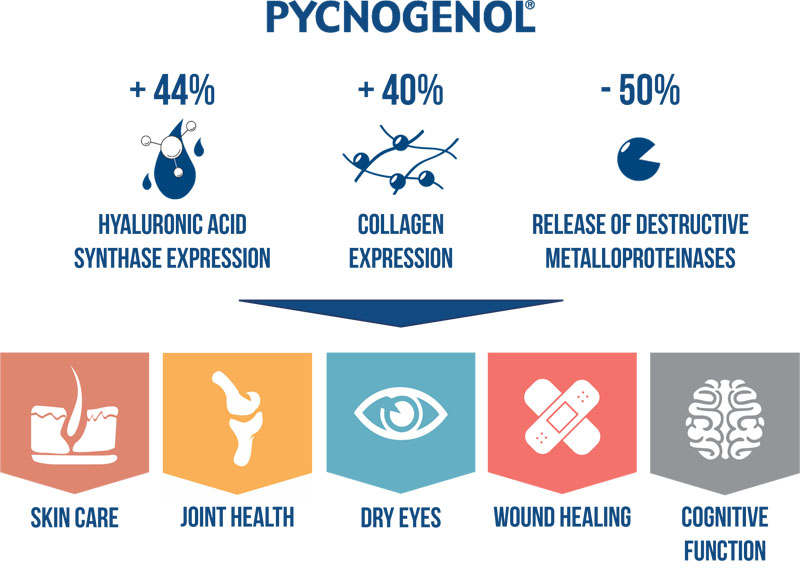
Figure 1: Pycnogenol for tissue support
Improved skin hydration and elasticity
To better deal with external stressors such as solar radiation, heat, humidity, temperature changes and/or air pollution, healthy skin should be well hydrated and show a high level of elasticity.
To achieve that, skin consists of different components — such as collagens — that make up more than 30% of the extracellular matrix.
They act as supportive tissue material and bring stability and elasticity.4 Elastin (which, with fibrillin microfibrils, makes up elastic fibres) is crucial for elasticity and the extensibility of various tissues, including the skin.4
Another important component of the extracellular matrix is hyaluronic acid, which contributes to water retention in tissues and to their structural integrity.4
Skincare extends well beyond beauty as it plays a key role in our overall health.
Oral skincare offers additional benefits as it reaches the dermis — the inner layer of the skin — of the whole body. By increasing hyaluronic acid and collagen production within the body and protecting elastin and collagen from degradation, Pycnogenol was shown to increase skin elasticity, skin barrier function and skin hydration.5–8
In the 3-month study with 20 women mentioned earlier, a significant skin-hydration increase (21%) was noted in the Pycnogenol group, particularly in women presenting with dry skin before Pycnogenol intake.5

Pycnogenol was also shown to improve skin elasticity by 25% and decrease skin fatigue by 30%. In addition, Pycnogenol supplementation reduced skin wrinkles by 3% and increased skin smoothness by 6%.
In another study with 78 subjects who work outdoors in an urban area, Pycnogenol improved skin elasticity by 13% after 3 months (compared with a 1% increase in the placebo group).8
In this placebo-controlled double-blind study, Pycnogenol supplementation for 3 months reduced skin moisture loss during the hot summer season by 14% and by 3.3% with placebo (Figure 2).
In parallel, water loss of the skin (trans-epithelial water loss) during the hot summer season was reduced by 14% with Pycnogenol supplementation for 3 months and only by 5% with the placebo. This shows that Pycnogenol supplementation reinforced skin barrier function.
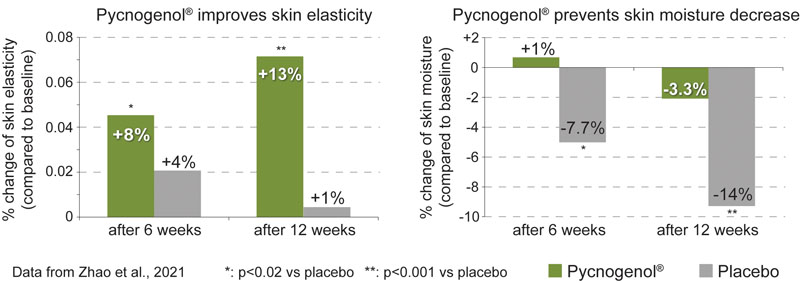
Figure 2: Pycnogenol improves skin elasticity and prevents moisture decrease
Another finding that supports Pycnogenol’s positive effects on skin barrier function was the increased expression of genes involved in keratinocyte differentiation and barrier formation, including loricrin, indicating that Pycnogenol supplementation was associated with improved formation of cornified envelopes and, thus, preserved skin hydration by reducing trans-epithelial water loss.9
Help with wound healing
As part of the extracellular matrix, collagen, elastin and hyaluronic acid are actively involved in the process of wound healing.10–12
As Pycnogenol improves the endogenous production of collagen and hyaluronic acid and prevents elastin degradation in the extracellular matrix, it explains why Pycnogenol has demonstrated efficient wound healing effects.5–7,13–16
In a study on the side-effects of oncologic treatment, Pycnogenol had a reducing effect on the incidence of soreness and ulceration in the mouth and throat (14.4% of the subjects) compared with the control group (26.4%).13
A study on venous ulcers derived from severe chronic venous insufficiency (CVI) showed that the area of ulceration was significantly reduced (88%) after 6 weeks of Pycnogenol intake compared to a reduction of 69% in control patients.14
In another study on ulcers in diabetic microangiopathy, Pycnogenol intake was shown to significantly contribute to wound healing (by 85%) after 6 weeks, compared with 61% in control patients.15
A similar study on venous ulcers in CVI showed a reduction of the ulcer area by 38.6% with Pycnogenol and by 31.5% in the control group using diosmin/hesperidin (Figure 3).16
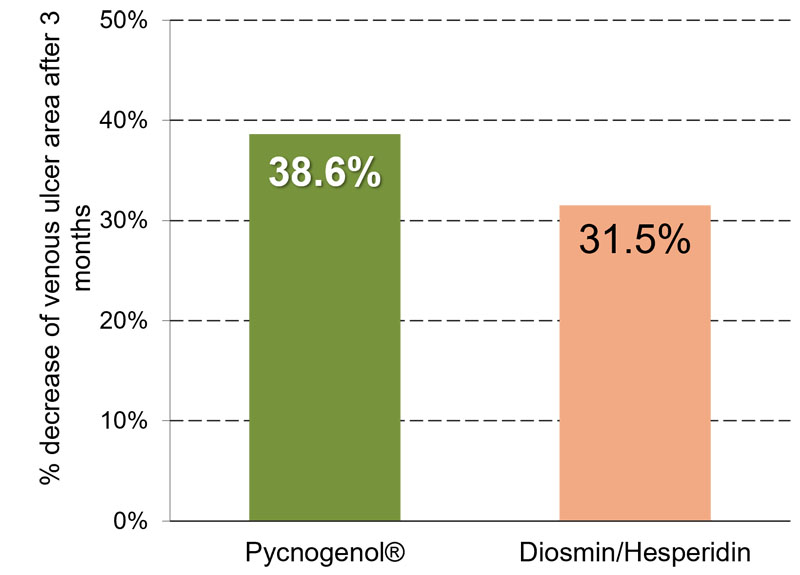
Figure 3: Pycnogenol for wound healing
Besides Pycnogenol’s support of the extracellular matrix, its potent anti-inflammatory efficacy and its established effects on microcirculation contribute to its impressive effects on wound healing.6,15,17–20
References
- www.who.int/initiatives/decade-of-healthy-ageing.
- N. Chylińska, et al., Gels 11(4), 281 (2025).
- O. Bar, et al., Cosmetics 12(4), 129 (2025).
- N.K. Karamanos, et al., The FEBS Journal 288(24), 6850–6912 (2021).
- A. Marini, et al., Skin Pharmacol. Physiol. 25(2), 86–92 (2012).
- T. Grimm, et al., J. Inflamm. (Lond.) 3, 1 (2006).
- T. Grimm, et al., Free Radic. Biol. Med. 36(6), 811–822 (2004).
- H. Zhao, et al., Skin Pharmacol. Physiol. 34(3), 135–145 (2021).
- S. Grether-Beck, et al., Skin Pharmacol. Physiol. 29(1), 13–17 (2016).
- T. Kobayashi, et al., Biomolecules 10(11), 1525 (2020).
- S.S. Mathew-Steiner, et al., Bioengineering 8(5), 63 (2021).
- X. Zhang, et al., International Journal of Molecular Sciences 23(8), 4087 (2022).
- G. Belcaro, et al., Panminerva Med. 50, 227–234 (2008).
- G. Belcaro, et al., Angiology 56(6), 699–705 (2005).
- G. Belcaro, et al., Clin. Appl. Thromb. Hemost. 12(3), 318–323 (2006).
- R.R. Toledo, et al., J. Ann. Vasc. Surg. 38, 212–219 (2017).
- A. Schäfer, et al., Biomed. Pharmacother. 60(1), 5–9 (2005).
- R. Canali, et al., Int. Immunopharmacol. 9(10), 1145–1149 (2009).
- R. Steigerwalt, et al., J. Ocul. Pharmacol. Ther. 25(6), 537–540 (2009).
- M.R. Cesarone, et al., Minerva Cardioangiol. 67(4), 280–287 (2019).