
Triggered by an overreaction of the immune system to allergens in the air, allergic rhinitis is an inflammation in the nose.26
Many people with allergic rhinitis also suffer from asthma, allergic conjunctivitis or atopic dermatitis.26 Several clinical trials suggest a relief of allergy symptoms and allergic asthma after intake of Pycnogenol.11,27–36
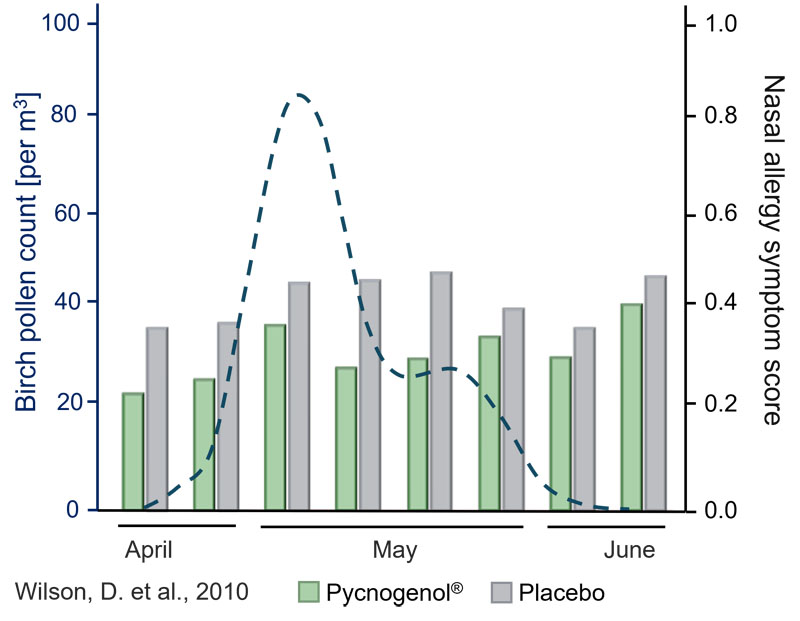
In a randomised double-blind placebo-controlled trial, researchers found that Pycnogenol intake improved allergic rhinitis symptoms in subjects allergic to birch pollen.27
Eye and nasal symptoms decreased in the Pycnogenol group. The number of patients requiring rescue antihistamines during the study period was 26% lower in the Pycnogenol group than in the placebo cohort.
In addition, birch-specific antibody titre was lowered by 36% with Pycnogenol compared with the placebo.
In addition to these direct antiallergic effects, an in vitro study investigated Pycnogenol’s effects on immune cells that are involved in allergic reactions.
Pycnogenol was found to dose-dependently reduce the release of histamine from the immune cells (mast cells).29 A similar study confirmed Pycnogenol’s dose-dependent effect on reducing histamine release from mast cells.30
In addition, the researchers observed that Pycnogenol decreased the activation of several proinflammatory markers in the immune cells. These results help to explain Pycnogenol’s effects against allergic immune reactions.
In clinical studies, Pycnogenol reduced symptoms of patients suffering from asthma.34–36 Asthma is a common chronic inflammatory lung disease that manifests with symptoms including cough, shortness of breath, chest tightness and wheezing.37
In a double-blind, placebo-controlled crossover study, the effects of Pycnogenol supplementation for 4 weeks on chronic asthma patients were investigated.34
After Pycnogenol supplementation, the patients could exhale 70% of their lung volume (compared with 59% at the start of the trial) and 63% with a placebo.
In addition, 4 weeks of Pycnogenol intake led to a reduction of symptom severity by 20.8%; it was only reduced by 2.1% in the placebo patients.
Furthermore, Pycnogenol significantly reduced proinflammatory mediators (leukotrienes) in the blood of patients (compared with both baseline values and the placebo).
Leukotrienes are known to play a crucial role in innate immunity; they are released by the immune system when it senses an allergen, causing airway constriction and excess mucus production — as observed in conditions such as asthma.
A double-blind, placebo-controlled study investigated the effects of Pycnogenol on 60 children aged 6–18 with mild-to-moderate asthma.36
The study showed that the breathing capacity improved significantly after 1 month of Pycnogenol intake. The severity of asthma symptoms, as well as leukotriene levels in the urine, decreased significantly after Pycnogenol supplementation (compared with a placebo).
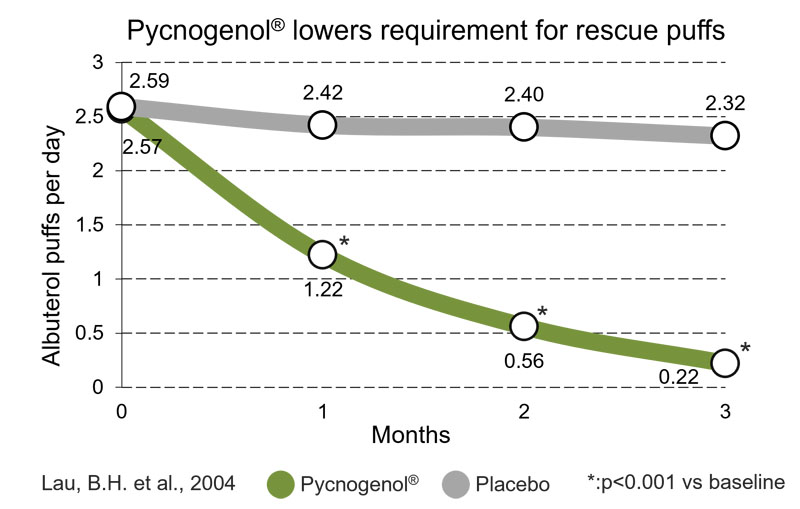
Interestingly, the necessity to use albuterol inhalers was significantly reduced as severe asthma attacks appeared much less frequently.
After 1 month, eight out of 30 children taking Pycnogenol didn’t require rescue inhalers anymore … and 18 children were completely off the inhaler after the 3-month supplementation period.
By reducing NF-κB activation, Pycnogenol lowers the sensitivity level to trigger an immune response, which helps to manage an asthmatic episode.8
MMP-9 is an enzyme that degrades connective tissue, including lung tissue, which greatly affects the pulmonary function of asthmatic patients. Its reduction by Pycnogenol adds to its beneficial effects for asthma patients.
Reduced autoimmune symptoms
When the immune system mistakenly attacks the body’s own healthy cells, chronic inflammation and autoimmune disorders can develop. Pycnogenol has been shown to have beneficial effects for symptoms of autoimmune diseases such as Sjögren’s disease, Lupus and Behçet’s syndrome.38–42
The affected subjects taking Pycnogenol had improved symptom scores and a decreased need for anti-inflammatory painkillers. Markers of inflammation and oxidation in their blood were reduced at the end of the study periods.
With evidence-based data for immune system support, Pycnogenol French pine bark extract is one of the most widely investigated natural supplements worldwide.
Pycnogenol has shown beneficial effects to improve symptoms of infectious conditions such as common colds or UTIs.
Other immune system disorders, including allergies, asthma and certain autoimmunity symptoms, were relieved as well by Pycnogenol’s potent anti-inflammatory and antioxidant effects.
References
26. L.M. Wheatley, et al., New England Journal of Medicine 372(5), 456–463 (2015).
27. D. Wilson, et al., Phytother. Res. 24(8), 1115–1119 (2010).
28. G. Belcaro, et al., Minerva Biotecnologica 28, 114–119 (2016).
29. S.C. Sharma, et al., Phytother. Res. 17(1), 66–69 (2003).
30. Y.H. Choi, et al., Phytother. Res. 23(12), 1691–1695 (2009).
31. S.M. Ross, Holist. Nurs. Pract. 30(5), 301–304 (2016).
32. C. Günel, et al., Balkan Med. J. 33(6), 620–626 (2016).
33. A.I.A. Unsal, et al., Graefes Arch. Clin. Exp. Ophthalmol. 265(7), 1299–1304 (2018).
34. S. Hosseini, et al., J. Med. Food 4(4), 201–209 (2001).
35. G. Belcaro, et al., Panminerva Med. 53(3), 57–64 (2011).
36 B.H. Lau, et al., J. Asthma 41(8), 825–832 (2004).
37. A. Papi, et al., Lancet 391(10122), 783–800 (2018).
38. R. Luzzi, et al., Minerva Cardioangiol. 66(5), 543–546 (2018).
39. G. Belcaro, et al., Minerva Med. 116(2), 106–112 (2025).
40. M. Cesarone, et al., Minerva Cardioangiol. 68(2), 146–152 (2020).
41. M. Stefanescu, et al., Phytother. Res. 15(8), 698–704 (2001).
42. S. Hu, et al., Minerva Cardioangiol. 66(4), 386–390 (2018).
For more information, contact Dr Franziska Weichmann, Manager of Scientific Communications and Product Development, Horphag Research.
Read Part I here.