The nutraceutical industry discovered women's wellness as a category only a few years ago. Ayurveda discovered women's wellness five thousand years earlier, and never stopped paying attention.
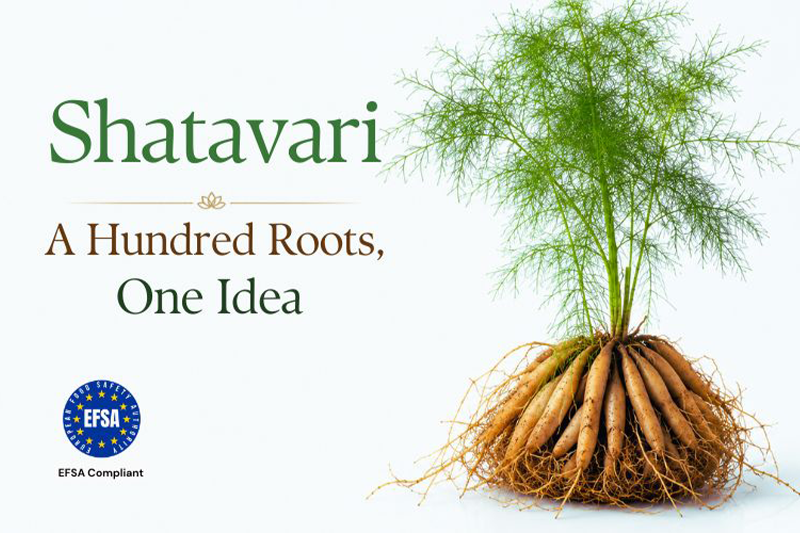
Nowhere is that head start more visible than in Shatavari. What does it mean for a plant's name to also be its anatomy? Asparagus racemosus, better known as Shatavari, answers that question underground. Above the soil, it's a thin, climbing vine, easy to walk past. Below it, a sprawling cluster of nearly a hundred tuberous roots tells the real story, and gives the plant its name: shat, a hundred, avari, roots.
One plant, many points of support
It's quite an unconventional thing for an ancient name to also be a fairly accurate description of physiology, but that's exactly what happened when Ayurvedic physicians started using this root centuries ago. A hundred roots feeding one system. One plant, many points of support. It's almost as if the plant's own architecture hinted at what it does inside the human body, because Shatavari has never been used for a single purpose. It has always been prescribed across a woman's entire hormonal lifespan, from menstrual irregularities to lactation to menopause.
A hundred roots feeding one system, that's not just etymology. It's close to a working description of how hormonal health actually functions
That idea maps neatly onto what modern science has since uncovered about women's hormonal health itself. The body isn't run by a single hormone but by a network: estrogen shaping the reproductive cycle, progesterone calming the nervous system, prolactin governing lactation, cortisol quietly determining how well the rest can function. Disturb one, through perimenopause, postpartum shifts, or chronic stress, and the effects surface as hot flashes, disrupted sleep, low energy, or mood changes. It takes a multi-rooted kind of support to hold that system steady, not a single fix.
A growing market, a clearer path
This is precisely the gap Shatavari has occupied in Ayurveda, and the one it's now stepping into in a measurable European Nutraceutical market. The EU women's health category is projected to grow at 5.1% annually through 2030, with menopause-relief launches up 21% and roughly a third of women managing PMS or menopausal symptoms now choosing natural remedies over pharmaceutical ones. In 2025, the European Medicines Agency clarified labelling requirements for botanical substances in menopause products, giving ingredients like Shatavari a clearer regulatory path into that growing demand.
The mechanism underground
Underneath its many roots, Shatavari carries steroidal saponins, the shatavarins, alongside racemosol and isoflavones. Structurally, these resemble estrogen closely enough to bind its receptors. Where estrogen is low, as in menopause, they lend a mild estrogenic effect. Where it's already high, they occupy the same receptors and moderate it instead, a dual action called selective estrogen receptor modulation. The same saponins support prolactin secretion, explaining Shatavari's traditional role for nursing mothers, while its adaptogenic properties help regulate the HPA axis, keeping cortisol from staying elevated and quietly undermining the rest of the hormonal network.
What does it mean for a plant's name to also be its anatomy? By now, the answer is clear: everything. A hundred roots for one plant, and a hundred small acts of support for one hormonal system trying to stay in balance. Shatavari was never describing its shape. It was describing its purpose.