

Supporting the overall well-being of young brains includes sufficient sleep, physical activity, effective study routines and balanced nutrition, reports Dr Franziska Weichmann, Manager of Scientific Communications and Product Development at Horphag Research.

Pycnogenol® French maritime pine bark extract is a natural ingredient emerging as a promising supplement for cognitive well-being.
Research has explored its potential to support aspects of brain health and cognitive performance in children and students throughout the academic year.
Pycnogenol was shown to reduce hyperactivity and inattention in children with ADHD (attention deficit hyperactivity disorder), which can typically contribute to problems in school owing to children’s concentration problems.1–7
In addition, studies have shown that Pycnogenol supports concentration and mental performance in university students and healthy professionals, helping to get back into an after-summer routine.8,9
ADHD as a global burden
Attention deficit hyperactivity disorder is a chronic, widespread neurocognitive behavioural condition and one of the most common diagnoses within child and adolescent psychiatry.10,11
Globally, 5–7% of children are diagnosed with ADHD and an additional 5% experience subclinical hyperactivity and inattention.12,13 In many cases, ADHD doesn’t stop when growing up but often persists into adulthood.14,15
Adult ADHD with childhood onset is a common disorder with a prevalence of approximately 2.5% worldwide.16,17
The number of adults who were diagnosed with symptomatic adult ADHD, regardless of childhood onset, is even higher. This equates to approximately 6.7% of the global population or 366 million people affected in 2020.17
These numbers show that ADHD represents a considerable burden for worldwide public health, especially as it is suggested that ADHD is frequently “unrecognised, underdiagnosed and under-treated.”16,17 But awareness of ADHD seems to be growing.15
For diagnosis, ADHD is described as “a persistent and pervasive pattern of inattention and/or hyperactivity-impulsivity that interferes with functioning or development” and resulting in “a negative impact on social and academic/occupational activities.”11,18
ADHD can lead to serious psychosocial impairments if not treated correctly, which includes psychoeducation, cognitive behaviour therapy and typically pharmacotherapy.15
A common medication for ADHD is methylphenidate hydrochloride (MPH, trade names include Ritalin, Concerta or Medikinet), which affects the central nervous system, leading to increased attention and reduced hyperactivity.11,19
It is, however, associated with various adverse effects, such as insomnia, decreased appetite, abdominal pain, headaches, depressed mood and a possible change of character.11,19
These disadvantages of the medication often lead to discontinuation of the treatment, creating the need for alternatives.
Owing to their potential beneficial effects on ADHD symptoms, dietary natural supplementation was proposed to help individuals suffering from ADHD.11
Research shows that Pycnogenol offers a broad spectrum of benefits for ADHD. In the 1990s and early 2000s, individual case reports described great improvements in the ADHD-associated behaviour in children and adults after taking Pycnogenol.1
These benefits were validated in placebo-controlled studies showing reduced hyperactivity and inattention in children with ADHD.2–7
Improvement of ADHD symptoms in children
A double-blind, randomised, placebo-controlled clinical trial in Belgium evaluated the effects of Pycnogenol and MPH in 88 children aged 6–12 years with diagnosed ADHD.2
Depending on their body weight, the children received either 20 or 40 mg of Pycnogenol per day, 20 or 30 mg of MPH per day or a placebo for 10 weeks.
Teachers and parents completed standardised questionnaires at regular intervals to evaluate the children’s behaviour.
A key instrument in ADHD evaluation is the “Social-Emotional Questionnaire,” which covers questions on hyperactivity, impulsivity, inattention, general social behaviour and anxiety.
According to the teachers, Pycnogenol intake led to a significant improvement (34%) in hyperactivity and impulsivity symptoms (Figure 1).
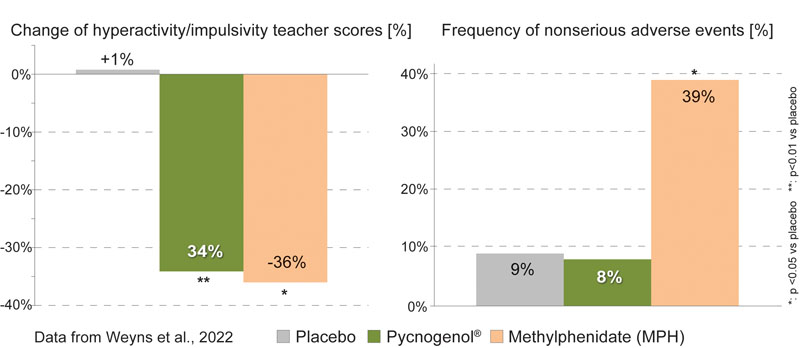
Figure 1: Efficacy of Pycnogenol® and MPH on child-ADHD symptoms after 10 weeks
The MPH group showed similar results, with a 36% improvement in hyperactivity and impulsivity symptoms, whereas the rating results in the placebo group slightly deteriorated compared with baseline.
Both Pycnogenol and MPH had beneficial effects on inattention in school, which was ameliorated by 25% and 52%, respectively.
Parents saw similar effects but to a lesser extent than the teachers’ results; both Pycnogenol and MPH outperformed the placebo, and MPH reduced hyperactivity and inattention more than Pycnogenol.
References
- P. Rohdewald, et al., “Children's Mental Health,” in Dr Stefan Siebrecht (Ed.), Health & Nutrition Books II, The Pycnogenol Phenomenon: The Most Unique and Versatile Health Supplement (Ponte-Press Verlags-GmbH, Bochum, Germany, 2015): pp 165–175.
- A-S. Weyns, et al., Journal of Functional Foods 97, 105246 (2022).
- A-S. Weyns, et al., Journal of Functional Foods 97, 105247 (2022).
- J. Trebaticka, et al., Eur. Child Adolesc. Psychiatry 15(6), 329–335 (2006).
- M. Dvorakova, et al., Nutr. Neurosci. 10(3-4), 151–157 (2007).
- Z. Chovanova, et al., Free Radic. Res. 40(9), 1003–1010 (2006).
- M. Dvorakova, et al., Redox Rep. 11(4), 163–172 (2006).
- R. Luzzi, et al., Panminerva Medica 53(3), 75–82 (2011).
- G. Belcaro, et al., J. Neurosurg. Sci. 58, 239–248 (2014).
- R. Drechsler, et al., Neuropediatrics 51(5), 315–335 (2020).
- A.A.J. Verlaet, et al., Nutrients 10(4), 405 (2018).
- K. Sayal, et al., The Lancet Psychiatry 5(2), 175–186 (2018).
- E. Abdelnour, et al., Missouri Medicine 119(5), 467–473 (2022).
- V. Salvi, et al., Riv. Psichiatr. 54(2), 84–89 (2019).
- G. Zalsman, et al., Int. J. Psychiatry Clin. Pract. 20(2), 70–76 (2016).
- M.A. Katzman, et al., BMC Psychiatry 17(1), 302 (2017).
- P. Song, et al., J. Glob. Health 11, 04009 (2021).
- American Psychiatric Association, “Diagnostic and Statistical Manual of Mental Disorders (Fifth Edition): https://doi.org/10.1176/appi.books.9780890425596 (2013).
- C.J. Wenthur, ACS Chem. Neurosci. 7(8), 1030–1040 (2016).
Part II of this article will delve deeper into the effects of Pycnogenol on schoolchildren and also examine its benefits for university students and young adults.


