
Cata-Kor, a US-based longevity-focused nutraceutical company, has released results from independent laboratory testing of 12 top-selling glutathione supplements purchased from Amazon's website in April 2026.
Cata-Kor said that, of the twelve products tested, six failed to meet their label claims for glutathione content.
It added that the findings indicate a broader quality problem in the glutathione category on Amazon, where liposomal and high-dose products have proliferated without consistent independent verification.
Testing was conducted by Swift Laboratory, an ISO 17025:2017-accredited third-party testing facility (ANAB Certificate No. AT-2969), using HPLC, which is the standard analytical method for quantifying reduced glutathione in dietary supplements.
Products were purchased directly from Amazon.com during April-June 2026 and submitted to Swift Laboratory for independent analysis.
Six out of the twelve brands tested failed to contain the stated amount of glutathione.
The results varied significantly in severity.
- Zeylamum, which claims 1300 mg of L-Glutathione per serving, had no detectable glutathione.
- Cenffitio, claiming 600 mg, also returned no detectable glutathione.
- Starehonorr, claiming 1000 mg, returned less than 20 mg — under 2% of the label claim.
- Prunucis, claiming 1200 mg, returned only 31.6 mg.
- CORPORALIGHT claimed 1500 mg and returned 256 mg.
- Alpha Flow, claiming 1100 mg, returned only 311 mg — less than 30% of the label claim.
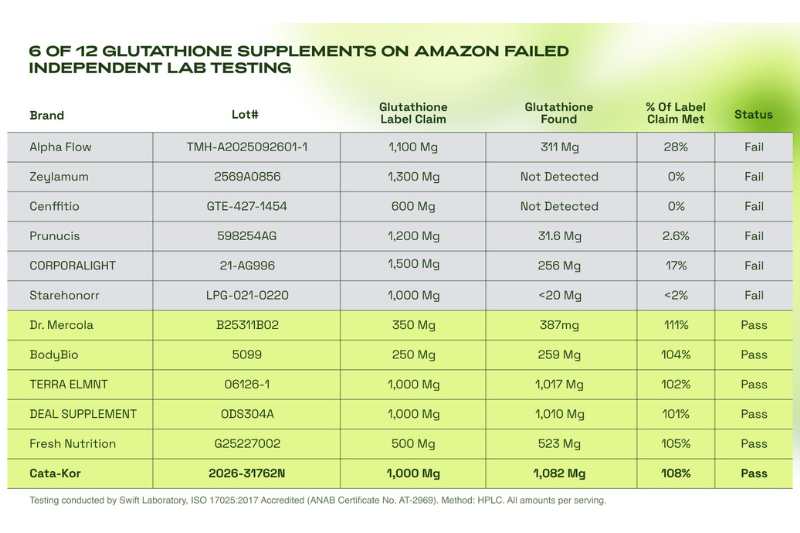
Cata-Kor said that its own Liposomal Glutathione passed testing across all measured parameters. Independent analysis by Swift Laboratory confirmed 1082 mg of L-Glutathione Complex per serving, exceeding the label claim of 1000 mg.
It added that the same test confirmed label accuracy for all co-ingredients: Vitamin C (64.8 mg vs 50 mg claimed), Riboflavin (6.79 mg vs 5 mg claimed), Selenium (71.0 mcg vs 55 mcg claimed) and Resveratrol (114 mg vs 100 mg claimed).
Heavy metals testing confirmed results well within USP safety limits.
"Label accuracy is the baseline, not a differentiator," said Dr Roman Miroedov, Product Development Lead at Cata-Kor.
When six of twelve products we tested failed to deliver what the label claims, that is a consumer protection issue. We are publishing these results because buyers deserve to know what they are actually getting.


